Most people think of river cruises when they hear the Viking Cruises name. Did you know Viking has ocean cruises too? Viking only recently, in 2015, joined the ocean cruise ranks with the Viking Star, yet they are on track to be the largest small-ship ocean cruise line by 2019 and already one-third of their revenue comes from their ocean cruises. Viking has been named the world’s #1 ocean cruise line by Travel + Leisure and Cruise Critic. What is the secret of their success? They know who their customer is and they do everything to make sure that customer gets the best experience possible. Viking has reinvented ocean cruising. Here are three reasons to choose Viking Ocean Cruises for your next ocean cruise.
Viking Ocean Cruises’ Ships are Comfortable and Elegant
As soon as you board one of Viking’s ocean cruise ships, which are all exactly the same, you can see the difference between Viking and other cruise companies. You aren’t surrounded by gold and mirrors and crystal chandeliers. The Viking Living Room, as it is called, is understated elegance; a wood staircase wider yet reminiscent of those in their river cruise ships, a slideshow of photographs taken by their resident photographer from Viking’s destinations around the world, and multiple levels with lots of wood, leather railings, and the minimalism of Scandinavian design.
There are lots of public spaces around the ship perfect for quiet relaxation. At the top of the ship are a sports deck, pool with lounge chairs, outdoor seating areas, and the Wintergarden where afternoon tea is served. Scattered around the ship are cozy seating areas, some with shelves of books nearby.
All staterooms on the ship have a veranda and are quite similar to the rooms on Viking’s river cruise ships. No interior rooms or tiny porthole windows. Bathrooms are small, providing just enough room to be comfortable, but not taking away room from where it’s important and not wasting space. Just like the Viking river ships, the bathroom floors are heated, one of my personal favorite features.
There are some things you won’t find on Viking’s ocean cruise ships: casinos, children under 18, umbrella drinks, photographers hawking photos, art auctions, formal nights, and smoking.
Viking Ocean Cruises Provides Experiences
Viking’s focus is not keeping guests on the ship to spend money, but rather providing them with amazing travel experiences. Because of this focus, their ocean ships are small, holding only 930 guests. Because of the ships’ smaller size, they can sometimes dock rather than having to shuttle passengers by boat. When only one day is spent in a destination, the ship arrives very early in the morning so guests have more time on land. They also sometimes overnight at a destination, allowing even more time on land.
Viking Ocean Cruises destinations include the Baltic, northern Europe, the Mediterranean, Asia, Australia, Central America, and South America. They even have an epic World Cruise, the first of which sailed out of Los Angeles on January 5, 2018. The 930 guests onboard the Viking Sun will spend 120 days visiting 27 countries. Some of those guests boarded 21 days earlier and visited destinations in Central America. Viking also has itineraries for a mix of both river and ocean, the best of both worlds.
Even on the ship, Viking provides experiences. Local music and lectures about destinations are offered. The restaurants offer both standard fare and local specialties. There is also an excursion offered that visits a local market where passengers can sample new things and ask questions, and then return to the ship in the evening to have a meal prepared with what they discovered at the market.
Viking Ocean Cruises Offers a Truly All-Inclusive Package
One of the things founder and Chairman Torstein Hagen hates is that cruise companies fleece their passengers once onboard. He believes that cruises should be all-inclusive with no hidden surprises. Viking’s ocean cruises include in the price one free shore excursion in every port; unlimited Wi-Fi; spa access; beer, wine, and soft drinks at meals; specialty coffees and teas; port taxes and fees; alternative dining (including the Chef’s Table); 24-hour room service; ground transfers with purchase of airfare; and free laundry machines. Not included are extra excursions, liquor and premium wines, and tips.
Dining at any of the ships' restaurants is included in the price, just some require a reservation. This even includes the Chef’s Table. One thing I noticed on the Viking ocean ship that is different from the river ships is that there are a number of two-person tables in the restaurants.
While there is a charge for spa treatments, all passengers can use the Nordic spa and workout facilities for free. The Nordic spa includes a pool with a water vapor fireplace, a steam room, a sauna, a snow grotto, a polar plunge pool, and even one of those showers where you pull on a rope and a bucket tips over, dumping freezing cold water over you, the quintessential Nordic experience.
One more note about Viking Cruises, not specific to its ocean cruises. Viking is a family business. Torstein Hagen founded the company 20 years ago, and his daughter Karine Hagen, SVP, will one day head the business. The importance of family can be glimpsed in Mamsen's, the ship's Norwegian deli named after Torstein's mother and serving her recipes on replicas of her dishes. They care about their 2,000,000+ customers, and they care about their 6,000+ employees, and they want to be the best company they can be for both groups. The plan is to always stick to their high standards and provide the best experiences on oceans, rivers, and land for decades to come.
Hanoi is Vietnam’s capital city, located in northern Vietnam. Hanoi is frenetic and has a reputation for its crazy traffic, mostly made up of motorbikes. It’s also known for its French architecture and mouthwatering variety of Vietnamese street food. On our Magnificent Mekong tour with Viking River Cruises, we had 48 hours in Vietnam. Even with that short amount of time, we were able to fit in a lot of the best things to do in Hanoi, including viewing Ho Chi Minh, visiting Hoa Lo Prison and a few temples, and eating a lot of delicious food, all while successfully dodging motorbikes, or riding on the back of one.
Ho Chi Minh Mausoleum
We could have visited Ho Chi Minh’s palace area and mausoleum with the Viking River Cruises’ included tour. However, they were visiting in the afternoon, after the mausoleum closes. While that does mean it was far less crowded when our fellow passengers visited, I really wanted to go inside Ho Chi Minh’s mausoleum, so we had to visit on our own.
The Ho Chi Minh Mausoleum reminded me a lot of the Chairman Mao Memorial Hall in Beijing, China. Ho Chi Minh actually asked to be cremated, but this much-revered leader of communist Vietnam was embalmed and put on display in a colossal marble mausoleum.
There is a huge line, but it goes pretty fast. In fact, we visited the mausoleum and the rest of the presidential palace area in two hours and 45 minutes. When in line, be sure to hold on to your place; pushy tourists will try to cut in front of you if you’re not paying attention. No cameras or large bags are allowed in the mausoleum, so we had to leave ours at the stand on one side, and they were available at the other side when we emerged.
Inside the mausoleum, four guards stand in a sunken well around Ho Chi Minh, who lays frail, pale, and waxy.
Since we were leaving Hanoi with our Viking River Cruises tour at noon, we had to make sure we made the most of our time. We took a taxi from the hotel, which was a good call because the taxi took us directly to where we needed to get in line, and told us exactly where to go. The complex is huge and, looking at the map, where he took us was nowhere near where I thought we would need to go.
Ho Chi Minh’s Vestige in the Presidential Palace Area
Located in the same complex that holds the Ho Chi Minh Mausoleum is Ho Chi Minh’s Vestige in the Presidential Palace Area. The most imposing structure in this area is the large yellow Presidential Palace, which is not open to the public.
Other places of interest in the presidential palace area include the flower trellis where Ho Chi Minh received guests, the meeting room where Ho Chi Minh chaired meetings and received guests, a garage of cars used to serve Ho Chi Minh, Ho Chi Minh’s humble stilt house in which he lived occasionally from 1958 to 1969, the one pillar pagoda built by Emperor Ly Thai Tong in the 2nd century, and Ho Chi Minh Museum which showcases his life with photos and official documents.
Hoa Lo Prison
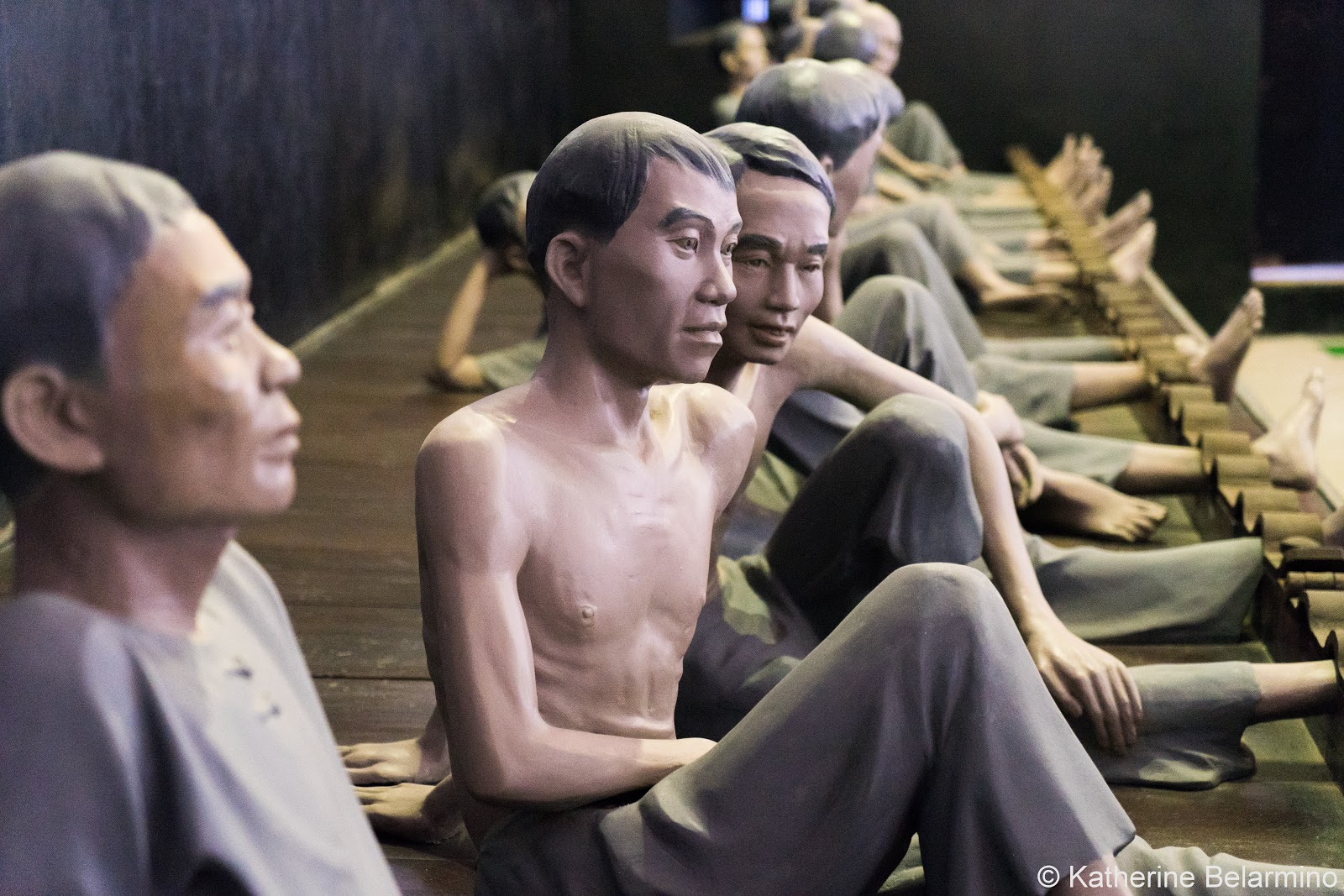
The Hoa Lo Prison Historical Relic is what remains of the Hoa Lo Prison, built by the French Colonialists in 1896 to imprison Vietnamese revolutionary fighters. Most of the exhibits of the prison are dedicated to this time in history, showing the inhumane conditions in which prisoners were held, shackled to cement floors, beaten, and tortured.
However, most travelers know the Hoa Lo Prison by a different name, the Hanoi Hilton. This name comes from the time the prison was used to hold American pilots who had been shot down during a bombing raid of North Vietnam. Perhaps the most well-known of these prisoners of war is Senator John McCain.
The name Hanoi Hilton came about because it was said the prisoners of war were treated as if they were staying in a resort. While we know that isn’t quite true, it is an idea that still seems to be sold to visitors.
Street Market Near the Temple of Literature
While we were walking from our hotel to the Temple of Literature, we stumbled upon an outdoor market. The benefits of walking through the market were twofold as we were able to avoid some of the crazy Hanoi traffic by walking through this mostly pedestrian section and also because we got to look at some of the local fruits, vegetables, and flowers.
Temple of Literature
The Temple of Literature is over 1,000 years old and is dedicated to Confucian scholars and sages and was used as a university. In addition to temples, there are statues of turtles with tablets standing on their backs listing names of doctors. There are statues of birds on turtle backs and Buddha figures. Exhibits portray the history of Confucian education in Vietnam. It is a place of peace and quiet in the middle of bustling city.
Bach Ma Temple
Bach Ma Temple is a small temple in the heart of the Old Quarter and is said to be the oldest temple in Hanoi. Its small size means it is crammed with statues, ornamentation, flowers, offerings of fruit and beer, and, when we were there, a white cat.
Traditional House at 87 Ma May
Another interesting site in Hanoi’s Old Quarter is the Traditional House (also called Memorial House and Ancient House), which is a traditional merchant’s house built at the end of the 19th century. The house is filled with traditional furniture and has rooms situated around two inner courtyards.
The type of architecture is sometimes referred to as a “tube-house” because of its narrow façade and succession of courtyards and buildings. The courtyards allow for good ventilation and natural light. The house was the first to be so well restored in the Old Quarter and was recognized as a Vietnamese National Heritage in 2004.
Food Tours
One of our favorite things to do when we travel is experience as much local food as possible. We worried we might not have many chances to do so while traveling with Viking River Cruises (though we ended up having more chances than we imagined) so we booked not just one, but two food tours with Hanoi Street Food Tours. Through these two tours, we not only had some of the best Vietnamese food of all our time in Vietnam, we also received quite an education in traditional Vietnamese foods and got a little sightseeing in as well.
The first food tour we took was the Seafood Tour by Night. I didn’t realize before we started researching food tours that seafood is such a big deal in Vietnam. On this tour we stopped at one place for a non-seafood appetizer then went to a seafood restaurant where we sat on short stools at tables on the sidewalk and had our fill of crabs, shrimp, clams, and cockles. We topped off the evening with a sweet treat, egg coffee.
The second food tour with Duc Ivan of Hanoi Street Food Tours was the Hanoi Street Food Tour, which combined stops at multiple hole-in-the-wall restaurants around the Old Quarter, each specializing in one regional dish, with visits to a handful of historical sites and a walking tour of the Old Quarter.
Hoan Kiem Lake at Night
There are a few bodies of water in Hanoi. One of those, Hoan Kiem Lake (Hồ Hoàn Kiếm), separates the French Quarter from the Old Quarter. The English meaning of the lake’s name is Lake of the Restored Sword. The legend is that the blade of a sword was fished out of water and made its way to Emperor Le Loi. Le Loi found the sword hilt separately. With the two combined, he was victorious in many battles. Later on, after the Chinese accepted Vietnam as independent, Le Loi was approached by a great turtle while boating on the lake in Hanoi. The turtle asked him to return the sword to the Dragon King. Le Loi immediately dropped the sword into the water and the turtle descended into the deep with the sword in his mouth.
In the lake is an island with a temple, the Temple of Jade Mountain, which is connected to the shore by a red bridge, Huc Bridge. Also in the middle of the lake is Turtle Tower. At night, all of these structures are lit and the lake is surrounded by the lights of Hanoi.
Temple of Jade Mountain
During the day you can cross the Huc Bridge onto Hoan Kiem Lake’s island and visit the Temple of Jade Mountain.
St. Joseph’s Cathedral
St. Joseph’s Cathedral is the oldest Roman Catholic Church in Hanoi. The church is located in Hanoi’s Old Quarter and was built in 1886 in a style to resemble Notre Dame in Paris. At night the area in front of the church is a gathering place for young people. The church is also a favorite spot for wedding photos for couples of all faiths. The cathedral is especially pretty during the Christmas season when it is decorated to the hilt.
Ride on the Back of a Motorbike
Riding on the back of a motorbike was not an adventure we had planned. In fact, I purposefully avoided planning such a thing. However, when Duc Ivan, our food tour guide, asked on our second tour with him if we would like to ride on the back of his motorbike and get a real taste of Hanoi life, we couldn’t pass up the opportunity. So off we went, three adults on one motorbike, no helmets, weaving our way through Hanoi’s crazy traffic. It was thrilling and one of my favorite memories.
Another way to have the motorbike experience is to use the Uber of Vietnam, Grab. With the assistance of an app, the company provides GrabTaxi, GrabCar, GrabBike, and GrabExpress. We saw the green-jacketed GrabBike guys all over Hanoi waiting to give someone a lift on the back of their motorbike.
Đồng Xuân Market
If you love shopping, a trip to Đồng Xuân Market is an absolute must. This market was originally built by the French in 1889, but was renovated in the 1990s after a fire almost destroyed the market.
Inside the market is multiple floors of wholesale goods for sale. You can pretty much by anything at Đồng Xuân Market including clothing, purses, dishes, luggage, shoes, dried goods, seafood and anything else your heart might desire.
History Tour at the Sofitel Legend Metropole Hanoi
Every day at 5:00 p.m., the Sofitel Legend Metropole Hanoi provides a Path of History tour of the old wing of the hotel. The highlight of the tour is the hotel’s bunker/bomb shelter. But there is more to the tour than that.
The tour starts with a little history of the century-old hotel and a look at some of the old china and silverware used. There is also an old issue of Life magazine with a photo on the cover that was the first photo to come out of north Vietnam by a foreign journalist. The photo shows the small bomb shelters that lined the sidewalk outside of the hotel. While the hotel has a bunker many feet below the ground’s surface where VIPs would be sheltered, the hotel staff and the common people did not have that luxury. Along the sidewalk were little more than manholes just deep enough for a person to crouch inside and block the top with a cover. It didn’t seem possible that these close to the surface, tiny, cramped spaces would provide any real protection. They still exist, but now there are trees planted in them.
The tour then continues down the hallway where there are a number of photographs of important and famous people that have stayed at the Sofitel Legend Metropole Hanoi. While hearing the stories of the various VIP guests, it was interesting to get a glimpse into how the people of Vietnam view America’s involvement in the war. In Hanoi, which was part of North Vietnam fighting for communism, against South Vietnam with whom America fought to achieve democracy, celebrities like Joan Baez and Jane Fonda are thought of well. Joan Baez stayed at the hotel and wrote a song while there, Where is My Son, highlighting the pain and sorrow the citizens of Hanoi experienced during the war. Jane Fonda, also known as Hanoi Jane, was in the hotel’s bomb shelter during a raid and spoke out against the war. We didn’t hear any animosity towards Americans for their involvement in the war. Rather, we heard how people who fought in the war, like John McCain, have come back to Hanoi recently to visit and express their goodwill. When we later visited the south of Vietnam, we also felt no animosity, but there it seemed more like the people were grateful America had joined them in the war, but perhaps a little wistful for what might have been if America had not withdrawn so early, as some believe the south would have won if America had stayed in the war a little longer.
Our final stop on the tour was the bunker, where we descended the steep staircase and donned hard hats to protect us from the low cement ceilings. Rather than being one big room, the bunker is divided into many small, narrow rooms. This provided extra stability and support, as well as the hope that if one room failed, the others might still stand. In the final room we visited in the bunker, we listened to Joan Baez sing Where is My Son. We ascended the stairs and were provided with a warm, spiced hibiscus beverage at the conclusion of the tour.
This tour is exclusively for guests. If you can’t join the tour, you can still walk around the lobby and ground floor hallway of the original wing to view the old photos and other items on display. Then head outside to the front left corner of the outdoor Bamboo Bar where you will see a stairway leading below ground. If the gate is unlocked, you may be able to go downstairs and view the bunker on your own.
While in Hanoi, we explored the city on our own. While Viking puts together phenomenal tours that hit most of the points of interests that travelers will want to see, plus provides historical information that you may not learn otherwise, when we are in a big city, we prefer to see it on our own. Also, we were most interested in starting our time in Vietnam with an education on traditional Vietnamese food, which conflicted with the Viking tour schedule, and we preferred to see Hanoi by walking and the occasional taxi and motorbike ride, rather than getting from place to place by tour bus.
However, if you are traveling with Viking and want to join the tours, they see many of the places we describe above with a couple exceptions and a couple extras. The Viking tours of Hanoi include the Museum of Ethnology, Temple of Literature, Ho Chi Minh Palace Complex, Hoa Lo Prison, and an electric car tour of the Old Quarter. All of these tours are guided, meaning you will get more information about each site than if you visit on your own. Also, if joining the tour, all entrance fees are covered, while if you visit sites on your own, you will have to pay your own entrance. Entrance fees are usually only a dollar or two. As mentioned above, the Viking tour does miss entering the Ho Chi Minh Mausoleum as their visit to the Ho Chi Minh complex is in the afternoon, after the mausoleum has closed, when it is far less crowded.
Where to Stay in Hanoi
One of the best hotels in Hanoi is the Sofitel Legend Metropole Hanoi, a 5-star hotel with a long history. We were traveling with Viking River Cruises and this was the hotel we all stayed in. Since we did the Ha Long Bay extension, we stayed at the Sofitel Legend Metropole for a total of three nights, one night before heading to Ha Long Bay and two nights afterward, when we explored Hanoi.
The Sofitel Legend Metropole Hanoi is located in Hanoi’s French Quarter close to the Opera House. Its architecture is distinctly French Colonial and the hotel has been around for over 100 years, having been built in 1901. It has always been THE place to stay in Hanoi, having had countless dignitaries and celebrities as guests like Joan Baez, Jane Fonda, and Bill Clinton, just to name a few. It is one of the top three hotels in Southeast Asia.
There are two parts to the hotel, the original hotel and the newer opera wing, which is where we slept. The two wings surround a courtyard which holds the pool and the outdoor Bamboo Bar.
While all of the hotels in which we stayed during our Viking Mekong trip were excellent, this was probably my favorite one of the bunch. Perhaps it was because the big spacious room with its comfy bed and its spectacular view of the courtyard, decorated with a huge Christmas tree made entirely of nón lá (the traditional Vietnamese conical hat), all of which greeted us at 2:00 in the morning after two flights had been delayed, one of which we caught only because of a Christmas miracle, negating what had seemed to be the inevitable overnight in the Seoul airport. Or maybe it was the amazing breakfast buffet which allowed us to start our trip immediately with Vietnamese food, a breakfast of phở, bánh cuốn, and tropical fruit (Western options were also available).
Hanoi Tip – How to Cross the Street
The most valuable lesson one must learn if exploring Hanoi by foot is how to cross the street. Because practically everyone drives a motorbike and hardly anyone drives a car, there are myriads of motorbikes everywhere.
Not only are the streets filled with motorbikes, the sidewalks are filled with them. Sidewalks are first and foremost for parking motorbikes. Sidewalks are also for driving motorbikes more frequently than you’d imagine. Sidewalks are also for serving food and selling goods. Sidewalks are even for playing badminton. Sidewalks are also for walking, but that’s more of an afterthought. So, when you’re walking on the sidewalk, always be on the lookout for a motorbike coming from in front of you, from behind you, from an alley, or even from a doorway.
Getting back to crossing the street, the street is a sea of motorbikes. Traffic lights are a mere suggestion, as are traffic directions. Therefore, even if you are crossing a street at an intersection with a green light, that is no guarantee there will not be a hundred motorbikes coming at you. They will still be turning right without stopping. They will be turning left without stopping. They may be coming straight through their red light without stopping.
The key to crossing the street in Hanoi without getting maimed or killed is to commit, go slow, and go at one speed without stopping. Actions that will get you hit are running and stopping. Motorbike drivers see you crossing the street. They are actually very skilled in watching everything going on around them as they are also contending with motorbikes driving in front of them, behind them, and around them. When they see you walking, they gage your speed and calculate whether to drive in front of or behind you. Therefore, if they calculate that they can drive behind you and you stop, you will get hit. If they calculate that they can drive in front of you and you speed up or start running, you will get hit. Crossing the street in Hanoi is quite an art and very interesting to watch.
Thank you to Viking River Cruises for hosting us on their Magnificent Mekong tour through Vietnam and Cambodia and making this post possible. As always, all opinions are our own. This article contains affiliate links. If you purchase through them it costs you nothing extra and we earn a small commission which goes towards this website and bringing you more travel stories.