We’ve previously shared that our first and foremost reason for wanting to travel to Georgia was for the food.(Be sure to check out our article about Georgian cuisine.)We got our first taste of real Georgian food at a mix of Tbilisi restaurants ranging from casual to upscale.Here are six of our favorite Tbilisi restaurants from our trip to Georgia.
Bread House
Bread is a big part of Georgia’s cuisine. The ever-present khachapuri cheese pie starts with bread. When we walked into the Bread House we were immediately greeted with the sight of a baker baking bread in the Georgian bread oven, a round vessel with fire at the bottom and with sides so hot that when the baker slaps the dough onto the side, the bread sticks and bakes. While bread is Bread House’s specialty, it isn’t the only thing they serve, as they have a menu full of Georgian specialties. Bread House has a homey yet upscale vibe.
Bread House is next door to Abanotubani sulfur bath district and across the river from Metekhi Church of Assumption and King Vakhtang I Gorgasali Statue at 7 Gorgasali Street.
Maspindzelo! (მასპინძელო!)
Maspindzelo is part of the same restaurant group as the Bread House and is just next door. Maspindzelo is where locals go when they’ve had a late night and need some sustenance, usually in the form of dumplings or soup. Maspindzelo is where you want to go if you’re looking for an inexpensive, casual, Georgian meal. Khinkali are Georgian soup dumplings that are perfect with a cold Georgian beer, and Maspindzelo makes some of the best khinkali in Tbilisi. Just make sure you do it right by dousing your dumplings in black pepper. Maspindzelo is also known for khashi, a brothy soup of offal that is a popular Georgian hangover cure.
Maspindzelo is in the same building as Bread House at 7 Gorgasali Street.
Georgian House
We learned something interesting about Georgian restaurants. Typically in Europe, the best restaurants are small, cozy, and intimate. In Georgia, this isn’t the case. Georgians prefer their restaurants to be big and roomy with plenty of space between the tables. The Georgian House is a high-class Georgian restaurant. It is huge with lots of tables, lots of space, and lots of decoration inside to make it look 19th century. In addition to traditional Georgian food, Georgian House offers guests a complete Georgian cultural experience with Georgian music, Georgian dances, and Georgian films. We were fortunate enough to visit on the restaurant’s three-year anniversary and be entertained with performances of dance and song.
Georgian House is on the left side of the Mtkvari River at 2 Giorgi Tsabadze Street.
PurPur Gudiashvili Garden
PurPur Gudiashvilie Gardenis an upscale and eclectic Tbilisi restaurant that serves modern cuisine. PurPur is popular with locals and expats. When we walked in to PurPur we were greeted by a riot of colors, patterns, and textures in the form of floral upholstered chairs, mismatched tablecloths and rugs, and a mix of light fixtures and wall adornments. The food is not traditional, but rather leans towards the contemporary with items like sashimi and seafood salads. Be sure to visit one or both of the bathrooms, which are as lavishly decorated as the dining room.
PurPur Gudiashvili Garden is located at 1 Abo Tbileli Street near Lado Gudiashvili Square.
No. 1 Sakhachapure
No. 1 Sakhachapureis a casual, fast food type restaurant in the same building as the Rustaveli Cinema. As its name suggests, it is a popular place for khachapuri, a Georgian staple. Other fun things to order there are Lagidze water, carbonated soda flavored with natural flavors like grape, tarragon, or chocolate, and freshly made puffy pastries filled with vanilla cream. When these pastries are cooking, the entire restaurant smells of cinnamon and sugar.
No. 1 Sakhachapure is located in the Rustaveli Cinema on the corner of Shota Rustaveli Avenue and Anton Purtseladze Street.
Café Leila
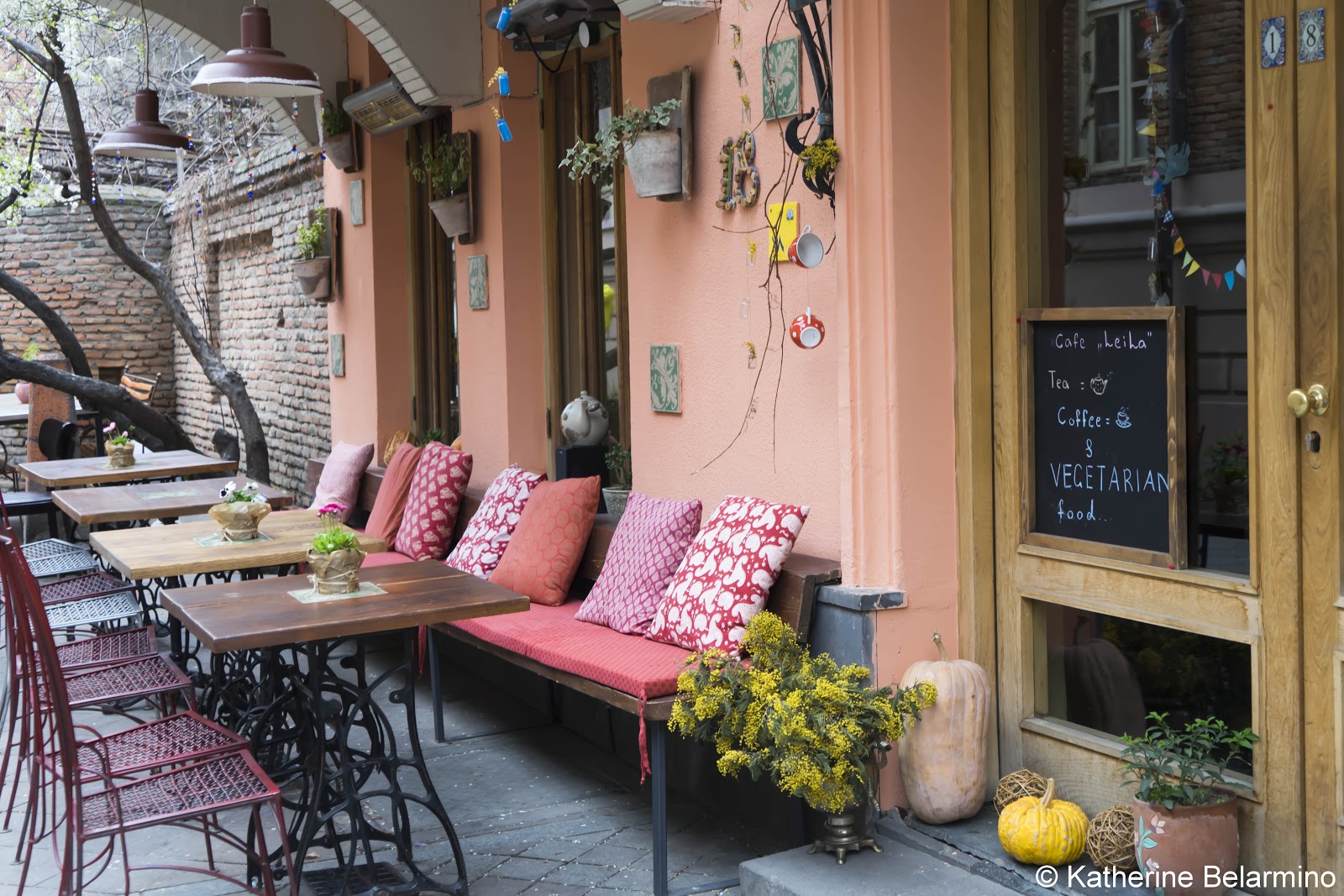
Café Leila serves traditional Georgian cuisine with a twist, because everything on the menu is vegetarian. We are far from being vegetarian, but we found we didn’t even miss the meat in Café Leila’s hearty vegetarian dishes. Our lunch included chvishtari, cornbread filled with cheese served with a beetroot and plum sauce (a thousand times better than any fried cheese stick), and vegetarian kharcho, made with eggplants and zucchini in a walnut and pomegranate sauce and served over hominy. The restaurant itself is colorful, decorated in a Moorish-inspired style.
Café Leila is located near the Rezo Gabriadze Theatre at 18 Ioane Shavteli Street.
Tbilisi, the capital city of the country of Georgia, can be a little intimidating at first. Tbilisi is a big, sprawling city with a mix of ancient sites, crumbling architecture, colors, both muted and vibrant, and new, modern structures that pop up amongst the old. The city is long, like a horn, as it is situated in a canyon. Most of the streets wind and curve, sometimes becoming alleys and occasionally even turning into flights of stairs. The main streets are wide and the flow of traffic is never-ending. Tbilisi has a palpable heartbeat and is buzzing with energy. But once you get acquainted with Tbilisi, it becomes easy and feels familiar, and there are so many things to see and do in Tbilisi to keep travelers occupied for days.
Metekhi Church of Assumption and King Vakhtang I Gorgasali Statue
The story of Tbilisi starts with King Vakhtang I Gorgasali, also known as Vakhtang Wolf’s Head because he had a wolf’s head on his helmet. Vakhtang Wolf’s Head was king of Iberia (eastern Georgia) from the mid-fifth century to the early sixth century. There are different versions, but, basically, the story goes that Vakhtang Wolf’s Head was hunting for pheasants. He shot one and sent his eagle to fetch it. When his eagle didn’t come back, he went after it to find that both had been boiled in hot springs. He was so impressed with the hot springs, he decided to build a city around them. The name Tbilisi means “warm location.” Overlooking the Mtkvari River which runs through the middle of Tbilisi is Metekhi Church as well as an imposing statue of King Vakhtang I Gorgasali.
Narikala Fortress
Just a short walk from Metekhi Church is a cable car that climbs to the top of the hill across the river. On this hill is the Narikala Fortress. Its name means “small fortress.” This fortress was first built in the fourth century. However, it, along with Tbilisi, has been destroyed and restored many times. The final blow was in 1827 when it exploded from the gunpowder stored inside.
Kartlis Deda (Mother Georgia) Monument
Also at the top of the hill near the fortress is Kartlis Deda, a statue of Mother Georgia. She is a symbol of Tbilisi. This tall aluminum statue is dressed in traditional Georgian dress. She holds a bowl of wine in her left hand for friends and a sword in her right hand for enemies.
National Botanical Garden of Georgia
Behind the Narikala Fortress is the National Botanical Garden of Georgia. The botanical garden provides a natural respite from the hustle and bustle of the city. We visited in March, so there wasn’t much in the way of flowers, but the botanical garden does have two waterfalls.
Tbilisi Mosque
Georgia is an Orthodox Christian country. Georgia was the third country to accept Christianity as its official religion. However, Georgia is proud of its religious diversity, and while its population is mostly Christian, it also includes Muslims and Jews. The Tbilisi Mosque is an example of this religious diversity and acceptance as both Shiite and Sunni Muslims worship together in the same Mosque. One side is for Shiites and the other side is for Sunnis, and the two sides are separated only by a couple columns.
Sulfur Spring Baths
In the Abanotubani (“bath district”) neighborhood across the river from the statue of Vakhtang Wolf’s Head are the Sulfur Spring Baths. The hill above Tbilisi is known for its hot sulfur springs, which run at 20 to 50 degrees Celsius. These are the springs that prompted Vakhtang Wolf’s Head to build the city. The sulfur baths are still an important part of Tbilisi’s culture. The baths are easy to spot as they are low buildings with red brick domes.
You can either go into a public bath or you can rent a private bath by the hour. Some of the private baths are quite nice, with a cold pool, a warm pool, a sauna, and a place to lay and get an added service of a massage or scrub. Baths open early and stay open late at night.
Old Tbilisi's Art Nouveau
A highlight of our time in Tbilisi was taking a walking tour of old Tbilisi and peeking into the old Art Nouveau buildings. Who knows how long some of these buildings will continue to stand. Many of them were private homes that have since been turned into apartment buildings, so the entryways can be entered while walking around old Tbilisi.
Caravanserai
An important part of Tbilisi’s history is its location along the Silk Road. A piece of the Silk Road that remains today in Tbilisi is the caravanserai. When you’re up at the Narikala Fortress, below you can see some buildings that are big rectangles with an open courtyard inside. These are remaining caravanserais. A caravanserai was like a B&B for traders. Traders would travel along the Silk Road with their camels and their goods. They would stop and stay at these caravanserais which had ramps in the courtyards that descended below ground where the camels would stay. The goods they had brought for trade were stored on the ground floor in storage rooms, and the traveling traders stayed in what were basically hotel rooms in the top floor of the same building as their goods and camels. These caravanserais were in business until the 1800s when the railroad came through. We got to peek into one of these buildings that now acts as an apartment building upstairs and a bar called KGB Still Watching You downstairs.
Tbilisi Sioni Cathedral
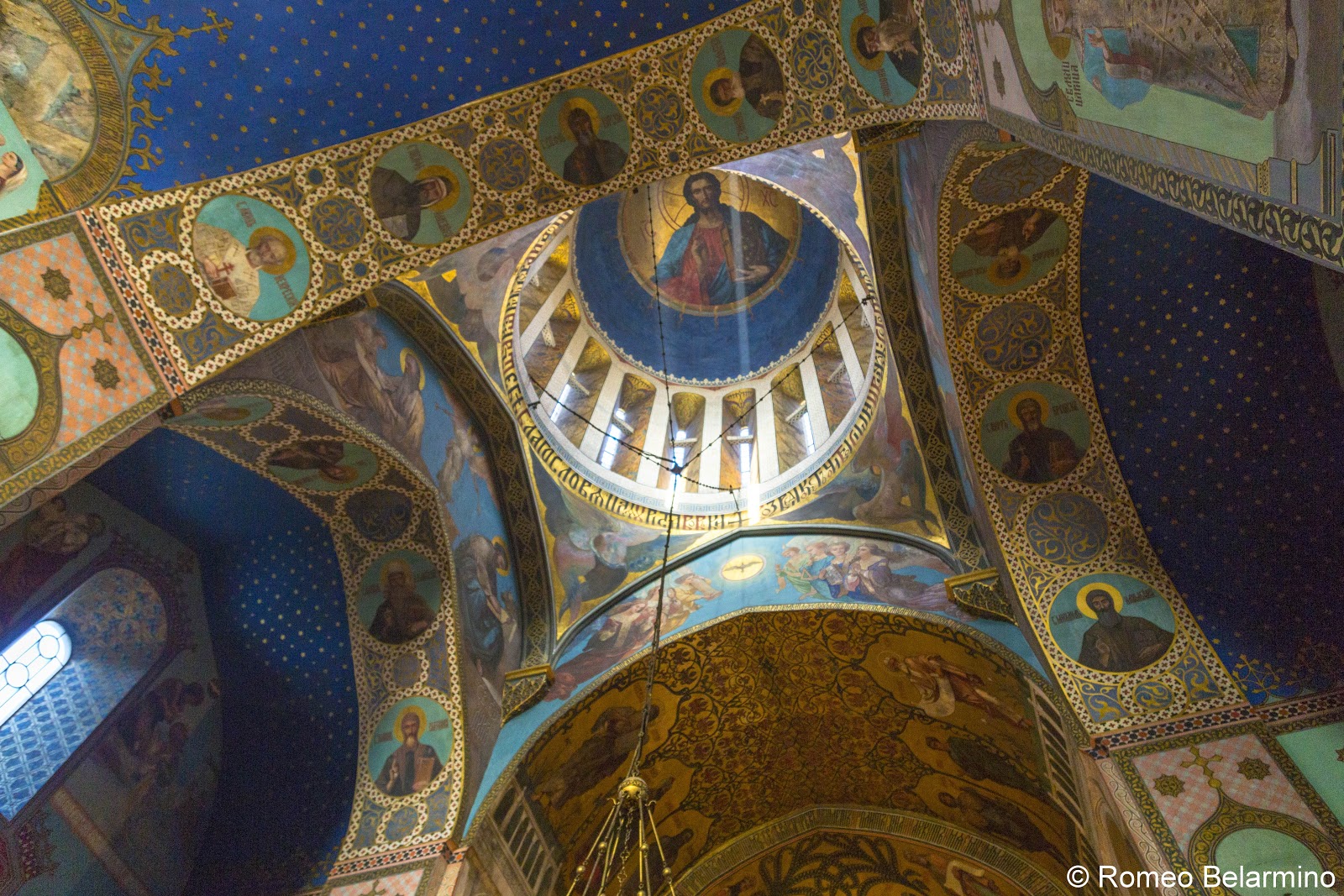
Tbilisi Sioni Cathedral is named after Mount Zion in Jerusalem and was the biggest church in Tbilisi at the end of the 5th century. That church was destroyed by the Persians and David the Builder built the current church in the early 12th century. The Russian iconography was painted in the mid-1800s. The church holds a grapevine cross, a symbol of Saint Nino, a Cappadocian woman who converted the Georgian King Vakhtang III to Christianity.
Meidan Bazaar
Another relic of the Silk Road is Meidan Bazaar. This may be one of the oldest business centers in Georgia. It may have been in use as early as the 4th and 5th centuries and it was a trade market on the Silk Road. A flight of stairs leads down into this underground shopping area. The market has been repurposed and now offers wine tasting and the possibility to purchase Georgian wine, Georgian cheese, churchkhela, jewelry, and other Georgian souvenirs. Related: Georgian Cuisine: 30 Traditional Foods to Try in Georgia
Bridge of Peace
Some people call the Bridge of Peace Georgia’s tampon. While I can see what they’re saying, I kind of like the juxtaposition of the modern Bridge of Peace and new theater buildings amongst the old. At night, the Bridge of Peace is lit with dancing white lights.
Holy Trinity Cathedral of Tbilisi (Sameba)
The Holy Trinity Cathedral of Tbilisi, commonly called Sameba, is the largest cathedral in the Caucasus and towers over Tbilisi. The cathedral can be seen from numerous points around the city. The architecture of the cathedral is inspired by traditional Orthodox Church architecture, but it is also the first of its kind. The head of the church wanted Sameba to last forever and ordered excavation until rock was found on which to lay the foundation. Rock was found at 30 meters, so the cathedral has a 30-meter foundation.
Sameba is actually churches within a church. As expected, there is a church on the main floor, but we followed stairs down to a stark underground church. There are a number of interesting items to be found in the main church, including a copy of the Panagia Portaitissa or Iviron icon. Legend has it the icon was put into the Black Sea to save it from being destroyed by the Byzantine iconoclasts and floated upright to Greece, where it was recovered from the sea by a Georgian monk and taken to the Georgian Iviron monastery on Mount Athos. The icon will remain on Mount Athos until the apocalypse. Another item of note is an altarpiece that tells the history of Georgia. The coat of Jesus in the altarpiece is covered in diamonds.
Anchiskhati Basilica of Saint Mary
Sheltered behind a fence and a bell tower is Anchiskhati Basilica of Saint Mary, the oldest church in Tbilisi. Anchiskhati Basilica was built by King Dachi, son of Vakhtang Gorgasali, in the 6th century. The name of the church comes from the icon of Ancha which was moved from the Ancha monastery in what is now Turkey to the basilica to protect it from the Ottomans. The icon is now on display at the Georgian Museum of Art.
Rezo Gabriadze Theatre
The Rezo Gabriadze Theatre staged its first puppet show in 1981. The theater was founded by Revaz "Rezo" Gabriadze, an artist, writer, and director. These puppet shows aren’t for children. The first show in the theater was a combination of The Lady of the Camellias and La Traviata performed by marionettes. The Gabriadze Theater company has toured in places like New York, Washington, D.C., Edinburgh, Toronto, and Paris. The theater is easily recognized by the fantastical clock tower that was added in 2011 for the 30th anniversary. Gabriadze built the tower, covering it with whimsically decorated tiles. Every hour an angel rings the bell with a small hammer. At noon and 7:00 p.m., an additional puppet show called “The Circle of Life” plays.
Georgian National Museum
The Georgian National Museum has many exhibitions related to Georgia’s history. One exhibition which should not be missed is the exhibition of the Archaeological Treasury. This exhibit displays gold and silver items from 3000 BC through 400 AD that were discovered in Georgia. Georgia’s treasure is available for public viewing because of the actions of Ekvtime Takaishvili, a Georgian archaeologist and national hero. When the Soviets invaded Tbilisi in 1921, the Georgian government was evacuated to France along with Georgia’s treasures. Takaishvili accompanied the treasure to France and preserved Georgia’s treasure, protecting it from being divvied up between the museums of the world. Even though he lived in poor conditions in France, he did whatever he could to protect Georgia’s treasure, including from a Nazi search during World War II. In 1945, at the end of the war, Takaishvili and Georgia’s treasure returned to Georgia.
The Soviet Occupation Museum
The Soviet Occupation Museum is currently in the same building as the Georgian National Museum, but will move to its own building in the near future. The Soviet Occupation Museum chronicles the Soviet occupation of Georgia from 1921 through 1991. The occupation is obviously a huge part of Georgia’s history. The exhibit is artfully put together with objects, photos, and documents and tells the stories of Georgians personally touched by the occupation.
Kashveti Church
Kashveti Church is another Georgian Orthodox Church in Tbilisi. Kashveti roughly translates to giving birth to a stone. Its name came from a monk of the 6th century that was accused by a woman of making her pregnant. The monk said that if she was lying, she would give birth to a stone, which she did.
A striking detail of Kashveti Church is the frescoes by Lado Gudiashvili. Lado Gudiashvili was a Georgian painter of the early 1900s. His paintings had a signature style, with people having very distinct and unique almond-shaped eyes. This style can be seen in Mary and the baby Jesus. This is a very different presentation of Jesus and Mary than is seen in other churches. They seem very human and of this world, rather than spiritual and ethereal. Our guide Anna said Georgians paint gods like humans and humans like gods.
Georgian National Opera Theater
One of Georgia’s iconic buildings is the Georgian National Opera Theater. The opera house recently reopened after a long renovation to heal the scars left by the Soviet occupation and Georgia’s civil war. The opera house is part of Tbilisi’s collection of art nouveau and was even the inspiration for one of the buildings that used to be a private mansion. Even if you can’t get inside for a performance, you can view the architecture, peak in the windows, and enjoy the unique statues that can be found around the building outside.
Tbilisi Wine Factory #1
Georgia has been making wine for thousands of years. Of course, you can sample Georgian wine at any of Tbilisi’s restaurants, but a unique introduction to Georgian wine in Tbilisi is offered by Tbilisi Wine Factory #1. The historic factory was financed by David Sarajishvili, the brandy king of Georgia, designed by Alexander Ozerov, the Georgian architect, and built in 1896. The basement contains a museum of wine, 40,000 wine bottles including from the private collections of Napoleon, Stalin, and Romanov, all under lock and key by government order. The basement also contains ginormous Soviet-time wine barrels and enameled wine tanks.
In addition to this wine museum, Tbilisi Wine Factory #1 offers wine tasting, workshops in making dumplings or candy, a selection of restaurants, and a boutique hotel, Art Hotel Winery 1896.
Getting Around Tbilisi
A lot of the things to do in Tbilisi are within walking distance, especially in old Tbilisi. Crossing the street can be tricky. Georgians are pretty aggressive drivers and they don’t like to stop for anyone or anything. When crossing the street be sure to make eye contact and even put a hand out to let them know you will be crossing. Big streets like Rustavali Avenue have tunnels every few blocks to get from one side to the other, otherwise, you’d never get across the street. Fun fact, drivers don’t turn left in Tbilisi. They have to drive for blocks and blocks until they get to a built in u-turn or a roundabout.
Walking around Tbilisi feels safe, including at night. We walked one night from old Tbilisi all the way back to our hotel in new Tbilisi. However, taxis are also easy to find at Freedom Square and they’re inexpensive, just be sure to have where you want to go written down in Georgian by someone at your hotel in case the driver doesn’t speak English. Tbilisi also has a metro system.
Where to Stay in Tbilisi
We stayed at the Rooms Hotel Tbilisi and absolutely loved it. The Rooms Hotel Tbilisi is just off of Shota Rustaveli Avenue and less than two kilometers from Freedom Square and Old Tbilisi. The hotel has all the comforts and amenities of a modern hotel with the coziness and uniqueness of a boutique hotel.
While Tbilisi can be intimidating when you first arrive, we feel sure that you'll fall in love with Tbilisi, and the rest of Georgia, like we did. All it takes is getting out there, walking around the city, meeting the people, eating the food, and visiting the physical pieces of Tbilisi's history, both old and new. This article contains affiliate links. If you book through these links, it costs you nothing extra and we earn a small commission which goes towards running this website and bringing you more travel stories.
When I told the only other person I know who has traveled to Georgia that we were heading to this magnificent country, one of her many suggestions was to set aside time to walk through old Tbilisi to soak in the crumbling architecture and iconic Tbilisi balconies. So when our guide Anna offered to take us on an old Tbilisi walking tour to see the Art Nouveau architecture, we immediately said yes.
We were surprised to learn that there was more for tourists to Tbilisi to see than just what is visible from the street. If we hadn’t had a guide, we would have never known that additional treasures were held inside the entryways of these Art Nouveau homes. (By the way, in case your knowledge of architectural styles is as minimal as mine, Art Nouveau is a style of architecture and design with linear and curving designs that was popular from the late 19th century until World War I.) As many of them are now apartment buildings, it is sometimes possible to pass into the entryways where a few still retain their ornately painted ceilings, intricate stairway metalwork, and even wall decorations as well.
We first visited a curved tall building with interesting metallic work covering the windows on Rustaveli Avenue just southeast of Vano Sarajishvili Street. But that wasn’t our destination.
We walked behind that building and found a secluded courtyard in the middle of the block with an aqua home presiding over the tiny remnant of a garden with a fountain and statues. Most of the homes along Rustaveli Avenue were destroyed, but this one was saved because the son of the family acted as a doctor to Stalin and he asked for the home to be saved from destruction. The same family still lives in the home today and it is an example of how these old homes can be restored to continue standing for another century.
We continued passing through the block, walking through hidden courtyards surrounded by more modern and functional wood paneled balconies, some enclosed, some with clothes hanging from the line, until the block emptied out onto Alexander Griboedov Street. Heading southeast, we passed the Tbilisi State Academy of Arts and continued gazing at crumbling facades until we reached No. 14 Alexander Griboedov Street. This home was built by an Armenian gentleman with a successful fish business. The residence has two entries because he used the upstairs for his home and rented out the first level.
While gawking at and taking pictures of the painted ceiling inside, something unprecedented occurred. Two women who live in the building came home and asked if we wanted to come inside their home and see what the rooms looked like inside! Anna said this never happens, even if Georgians are known for the boundless hospitality. They might have thought we were foreign investors who might have the ability to help restore the building, or maybe they could just tell we were genuinely entranced by the building they call home. The lavish decoration, like carved wood trim painted with pastels and gold, which remains intact in their apartment is stunning. They told us their apartment was originally a guest room or entertaining room that held just one piano. Now the rooms of what used to be a residence for one family are separated into multiple apartments.
Our next Art Nouveau entryway along our old Tbilisi walking tour was across the street at No. 15 Alexander Griboedov Street. This was originally the home of an Armenian businessman who specialized in French wine.
We diverted course and headed back out to the main thoroughfare of Tbilisi, Rustaveli Avenue. Between Lesia Ukrainka Street and Zakaria Chichinadze Street is an important Tbilisi institution, the Tbilisi Classic Gymnasium. The Tbilisi Classic Gymnasium is one of the oldest educational institutions of Georgia.
Next door to the Tbilisi Classic Gymnasium is the old Parliament of Georgia. Georgia’s Parliament is now in Kutaisi, but the old Parliament building of Tbilisi still remains. This building was built after the Art Nouveau period. In front of the Parliament building is an April 9 memorial, which commemorates the tragedy that occurred on the steps of Parliament on April 9, 1989. On that day, an anti-Soviet demonstration was held. When it was dispersed by the Soviet Army, 20 people were killed and hundreds of others were injured. Today April 9 is a national holiday, the Day of National Unity.
We continued down Rustaveli Avenue until we reached Freedom Square, a huge roundabout that circles the gleaming gold statue of St. George. From there we headed up Giorgi Leonidze Street, which used to be known as the warm street because both sides of the street were always sunny, no matter the time of day. This is no longer the case today, however.
This is the beginning of the Sololaki District, which used to have a water system used to water the gardens. One hour of watering would cost one silver coin. In the middle of the 19th century, the Russians blocked the water channels and made the area a dry area. The land of the Sololaki District became very expensive and European-style buildings designed by the best Georgian, Russian, and Armenian architects were erected in this part of Tbilisi, mostly between 1880 and 1910. The Sololaki District has also been called little Paris because the streets are set up in a grid pattern rather than curving and winding every which way like in other parts of Tbilisi.
Turn your eyes up at No. 3 Giorgi Leonidze Street, which used to house the Tbilisi Mutual Credit Society. An Armenian architect decorated the outside with Pluto and Mercury. A third story was added during Soviet times, but fortunately, this addition did not alter the original decorative appearance of the building.
A few doors down we stepped into No. 8 Giorgi Leonidze Street. It just looks like a standard drug store from the outside. The previous occupant of this building needed to pay off his debt so entered the Russian army. For his service in the war with Turkey in 1878 he was given the building as a gift. He had always wanted to be a pharmacist, and his pharmacy became quite popular. Today his original pharmacy cabinets still stand, but now they are filled with Nestle. Across the street from the pharmacy is an unusual looking building, even for old Tbilisi. Through the oval entryway with its sunflower façade used to be a women’s glove maker shop.
I don’t know the story behind No. 9 Geronti Kikodze Street, but I love the metalwork of the curving staircase. This is one of the brighter of the entryways of old Tbilisi. The walls have been painted solid colors, but the artfully painted ceiling still remains, though it is hanging on by a thread as it is cracked, with small sections looking like they might drop to the floor at any second.
Heading deeper into the Sololaki District, we came to No. 58 Lado Asatiani Street. The outside of the building is quite well preserved, with its reddish-brown brick walls, arched doorway and windows, and curved balconies framed with iron railings. The wooden door is a work of art with lion heads scattered amongst the iron scrolls. As we walked through those doors we were greeted with the word “salve,” which means welcome in Latin, embedded in the cracked tile floor. This entryway is very colorful with green painted walls scratched and graffitied. The peeling painted ceiling is a vibrant combination of coral, blue, yellow, and white with a mix of flowers, swans, urns, and devilish-looking figures with horns, wings, and tails, some playing trumpets.
When we entered the doors of 4 Daniel Chonqadze Street, we were greeted by a dark entry with seemingly endless flights of stairs heading upwards. This house looks down at all the other houses around and has two entrances, one from the street above and one from the street below. While the lower half is strictly graffitied white walls, as we ascended the stairs we encountered wall decorations and water damaged painted ceilings. We walked out a door at the top which led into a small hidden garden. The outside is different from the surrounding Tbilisi architecture as it has more of an English Tudor look.
No. 13 Ivane Machabeli Street is another Art Nouveau old Tbilisi home restored to its previous glory. The construction of the home was commissioned by David Sarajishvili, an awarded Georgian brandy producer, patron of the arts, and philanthropist, who lived in the residence from 1905 to 1911. The German architect Carl Zaar headed the construction along with Georgian architects Alexander Ozerov and Korneli Tatishev. The home later changed hands to Akaki Khoshtaria, an entrepreneur, philanthropist, and famous public figure, who lived there from 1918 to 1921.
Today it is the Writers’ House of Georgia, an open space for Georgian culture. When we visited they were still restoring the upstairs, but they let us walk through the ground floor rooms. The outside garden has gorgeous tiling and has a display of old photos showing how the rooms used to look. The garden is also an example of how the Tbilisians moved their signature balconies from the outside of their homes to the inner courtyards to conform to European design during the Art Nouveau period.
On the even-numbered side of Galaktion Tabidze Street (I didn’t see a number, but it might be 20) we entered a dark portico unique from others we had entered because of the paintings on the walls. Unfortunately, they have seen better times. You can see the vibrant colors peeking through the blackness. In Soviet times, the paintings were covered with lacquer to preserve them from being destroyed, but unfortunately, this damaged the paintings. The paintings, painted by a Jewish artist, depict a different area in the world. The first, of course, is Russia, and others include Africa, America, Asia, and Europe. Most of the wall and ceiling paintings heading up the stairs have survived as well.
Our final stop on our old Tbilisi architecture walking tour was about a block up from Jerusalimi Street at No. 4-6 Betlemi Street. As you’ll notice from the street names, this is the Jewish Quarter of Old Tbilisi and this is a typical Jewish wooden house with an outdoor covered entrance with stained glass and an ornate wraparound balcony with lace-like latticework.
Many of the Art Nouveau buildings of old Tbilisi are protected as historical structures. However, they cannot be restored quickly enough. Some are on the verge of crumbling and some have already collapsed. Hopefully these architectural treasures will be preserved and restored, but just in case, be sure to visit these ornate relics from the past while you can.
Of course, you can make your own walking tour of old Tbilisi and use this as a guide (hopefully my frantic note taking was enough to get you to the right places), or create your own tour and peek into the buildings that peak your interest. But if you want to be guided by an expert of old Tbilisi and its Art Nouveau architecture and learn the stories behind the buildings, you may want to hire a guide. You can try to book an old Tbilisi walking tour with our guide Anna Koripadze (anakoripadze@yahoo.com) or, if she is unavailable, she can suggest another guide for you. What I know for sure is that once you have a taste of what these old buildings hide you’ll peek into every open entry you pass with the hopes of finding a new treasure.






.)


